Project outcomes and key learnings

In-depth breakdowns of website replatforming, brand launches, and search-led organic growth strategies.
Transforming a customer-first website through content strategy, UX collaboration and Webflow.

Essential Living undertook a full migration from Kentico to Webflow to build a faster, more flexible website that better supported marketing, customer journeys and long-term growth. As Content Manager, I worked closely with senior stakeholders and developers to ensure the new website balanced user experience, SEO and content governance, while strengthening HubSpot integration and reporting.
Kentico was rigid and slow for the marketing team to update; the site lacked dynamic filtering, and prospective renters were bouncing to Rightmove and Zoopla because they couldn't quickly search for available apartments by price, location, or number of bedrooms on the site.
Google has started ranking domains with apartment portals more highly than those without. Our hypothesis was to introduce a portal page on the Essential Living Website. This should improve the user journey and encourage more website views and bookings. The goal was to create a higher-performing apartment search page and generate more consistent viewings/meetings booked, without reliance on external portals. We used competitors and larger-scale portal platforms to build a wireframe.
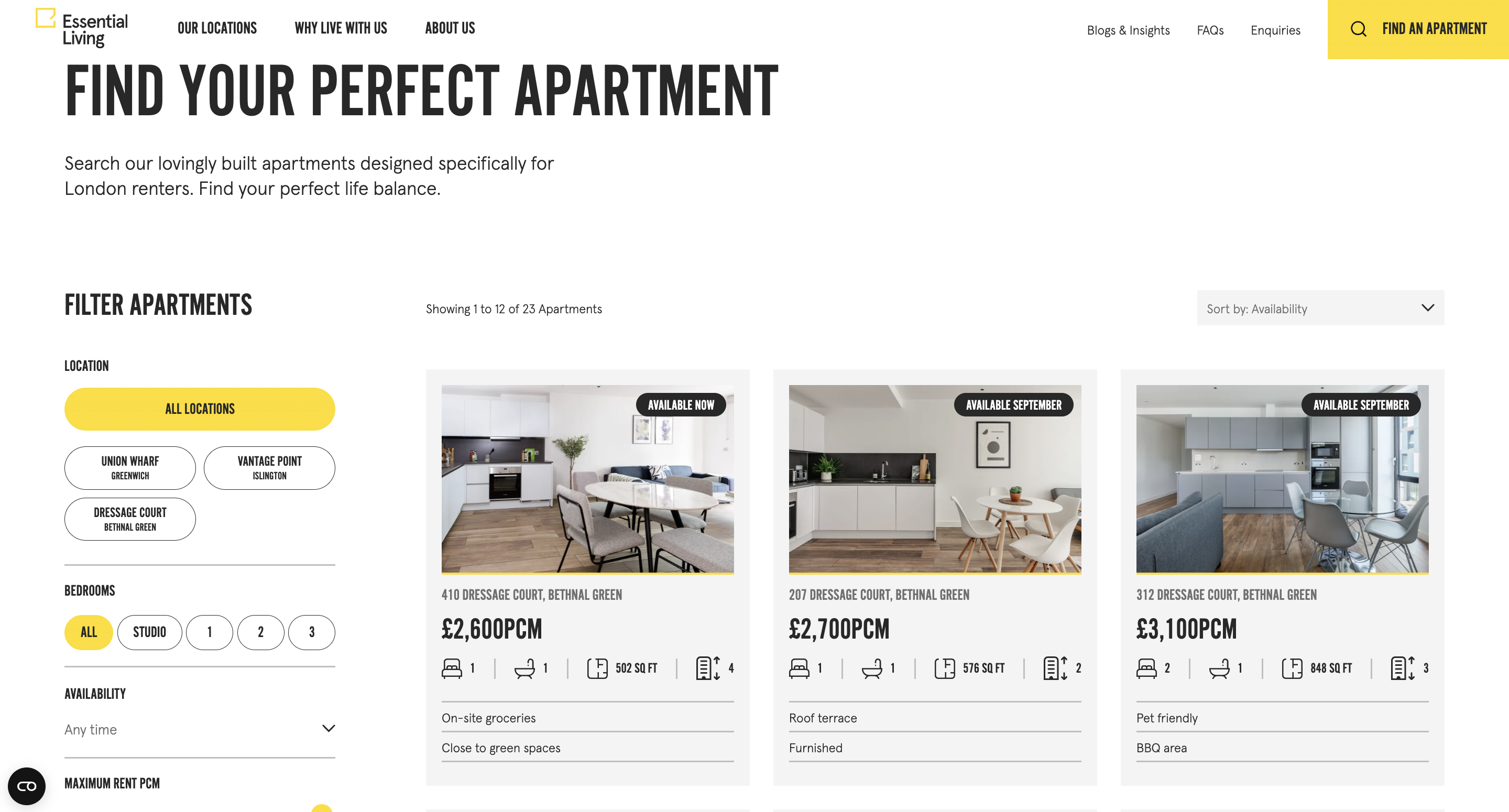
Tracking count of meetings booked per week across all channels.
Tracking total contacts month-by-month from June 2025 through July 2026.
• Planned and reviewed content migration
• Optimised landing page copy for targeted keywords
• Improved information architecture
• Maintained SEO best practice throughout the project
• Collaborated with developers on UX improvements
• Reviewed navigation and site structure
• Supported Webflow CMS implementation
• Improved customer journeys
• Supported HubSpot integration
• Improved reporting capability
• Enhanced lead attribution
• Strengthened marketing data visibility
By transforming a static marketing site into a faceted search portal, we captured high-intent rental demand directly—reducing reliance on third-party property portals, lifting weekly meetings by 92%, and increasing closed deals by 58% MoM.
Scaling organic reach and user engagement through search-driven seasonal content and GEO optimisation.
Rather than producing content for volume, my focus was on creating useful, search-led content that improved visibility while supporting the customer journey. Using data, keyword research and ongoing optimisation, I developed a long-term content strategy that increased engagement and organic performance.
The optimised evergreen content continues to deliver consistently high results. However, creating new content that also ranks well remains a challenge. With the growth of GEO and zero-click searches, achieving high SEO value is increasingly difficult due to these types of searches and AI summaries.
If we published seasonal, keyword-targeted content ahead of peak search demand and optimised it for both traditional SEO and GEO, we could capture a larger share of time-sensitive traffic than evergreen content alone, across both classic search and AI-driven search results.
Introduced a series of seasonal blogs (e.g. Christmas Lights Route, Best Christmas Day Lunch London) timed ahead of the seasonal search spike, structured to perform well against both traditional ranking factors and AI/GEO-driven search behaviour.
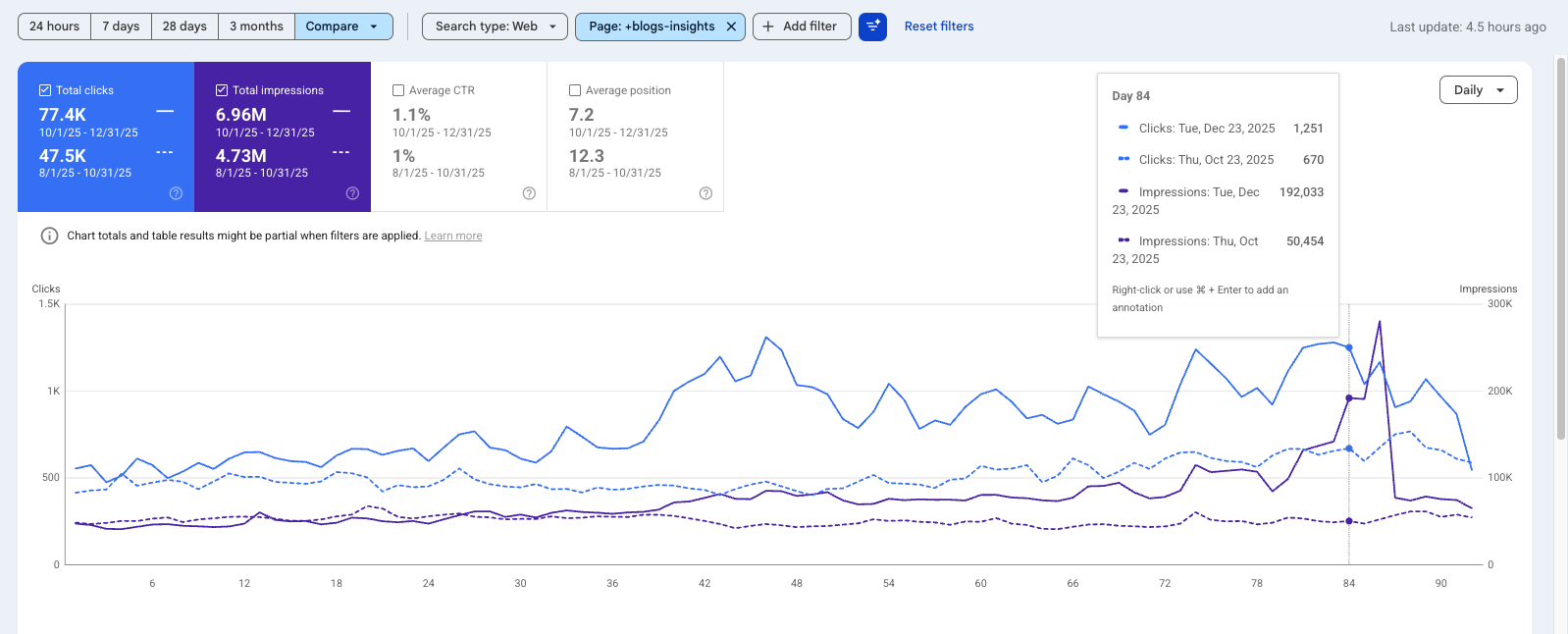
Comparing search clicks & impression totals for top blog posts (Data through 30th November 2025).
Tracking CTR (%) and Avg Position across top blog posts (Data through 30th November 2025).
• SEO planning
• Content strategy
• Keyword research
• Editorial planning
• Existing content refreshes
• Internal linking
• GEO optimisation
• AI Search optimisation
• Performance analysis
• Content reporting
• Continuous optimisation
• Search trend monitoring
The strongest SEO results come from understanding people first and algorithms second. That was reinforced when seasonal content, built for both traditional and AI-driven search, captured demand at its peak, well ahead of competitors relying on evergreen content alone.
Establishing an authentic, community-first digital identity for a new London rental brand from the ground up.
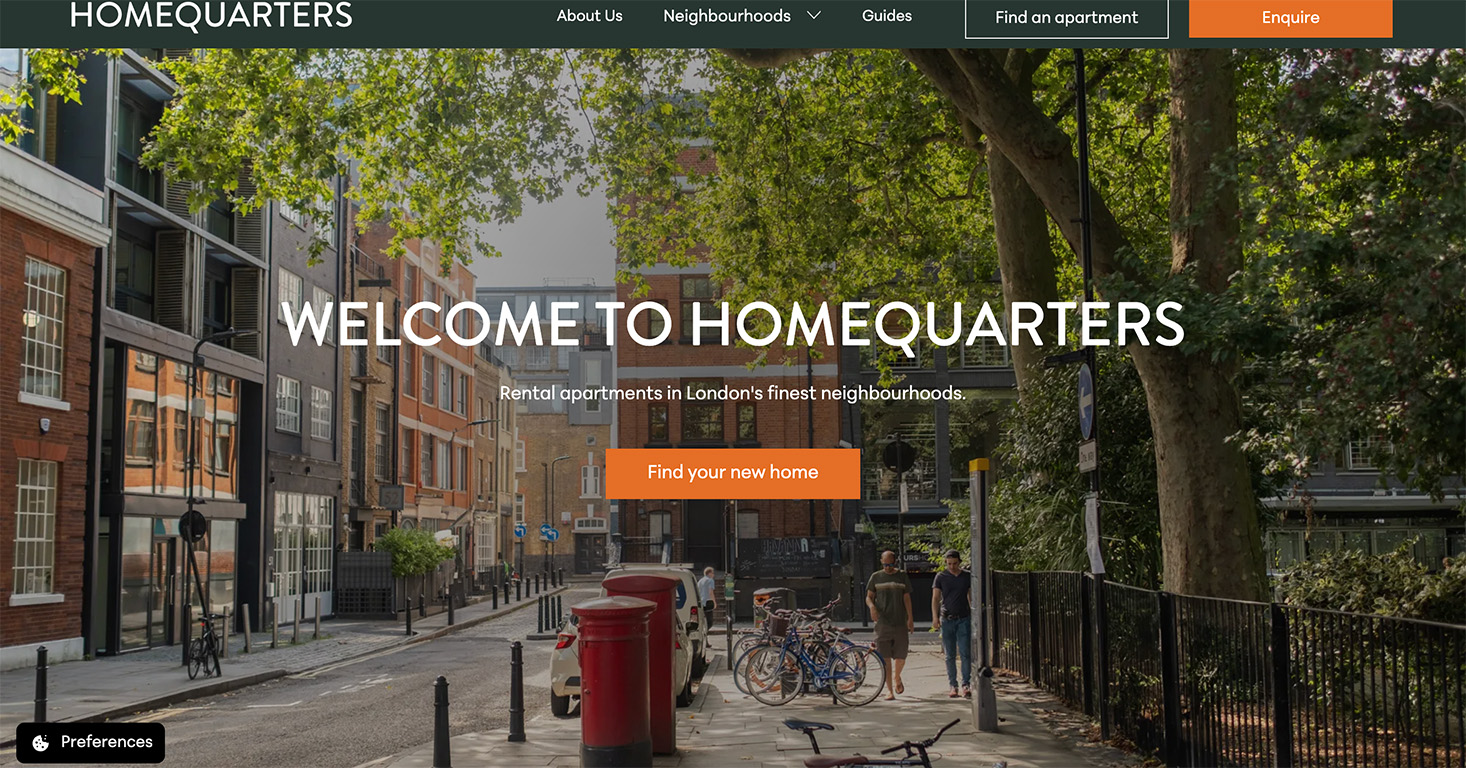
HomeQuarters launched as a premium residential brand needing a cohesive digital presence that translated physical living spaces into an aspirational lifestyle. Working across visual direction and digital production, I shaped how prospective residents experience the brand online, from the overarching tone of voice to neighborhood-specific visual storytelling.
Establishing immediate credibility for a new brand in London’s crowded rental market meant competing with established operators who already commanded trust. Through thorough competitor analysis, we uncovered a common weakness: while top players looked polished and credible, their digital presence often felt sterile, transactional, and overly corporate—relying on generic stock photos and stiff specification lists.
The opportunity was to combine that tier-one commercial credibility with genuine, localised storytelling. We needed to ditch generic stock imagery in favour of authentic, on-the-ground photography of the apartments and their neighbourhoods, while introducing a lively, playful tone of voice. The goal was to build a brand presence that felt both dependable and exciting, marketing not just square footage, but the lifestyle and personality of living there.
Benchmarked leading build-to-rent and boutique hospitality brands to identify white space for a warmer, neighbourhood-centric narrative.
Directed and produced localised lifestyle, architectural, and interior photography to provide authentic visual context for both the apartments and surrounding streets.
Structured landing page copy and content hierarchy around local lifestyle perks (cafés, commute times, green spaces) to connect prospective tenants to the community before asking them to book a viewing.
Structured landing page copy and content hierarchy around local lifestyle perks (cafés, commute times, green spaces) to connect prospective tenants to the community before asking them to book a viewing.

• Directed and shot on-location apartment and neighborhood photography
• Defined brand tone of voice: balancing credibility with playful, energetic copy
• Curated visual asset library and responsive image treatments
• Crafted localised neighborhood landing page narratives

• Shaped page layouts, visual hierarchy, and component wireframing
• Partnered on user journey mapping to minimize booking friction
• Led comprehensive User Acceptance Testing (UAT) across devices and breakpoints
• Refined desktop and mobile navigation structure for intuitive exploration

• Conducted competitor landscape analysis to uncover market white space
• Collaborated closely with Webflow developers and visual designers
• Managed stakeholder design and content review cycles
• Ensured complete brand consistency from discovery to final staging launch
Competitor research showed us how to build trust; storytelling showed us how to build desire. By replacing sterile stock imagery with authentic neighbourhood photography and an energetic tone of voice, we gave HomeQuarters a distinct, lifestyle-first identity that set it apart from day one.
Migrating from legacy Kentico to Webflow, saving £20k in development overhead, automating 153 apartment data transfers with AI, optimising conversion journeys via site-wide CTA audits, and modernising technical SEO for GEO.
Faced with the sunsetting of our legacy Kentico CMS, we executed an in-house rebuild and replatforming to Webflow. Applying core architectural and design learnings from our previous HomeQuarters launch, we combined modern AI workflows, rapid wireframing via Relume, and targeted developer advisory. This approach enabled us to migrate complex property data, audit and optimise conversion journeys with targeted CTAs, implement high-ranking schema, and elevate user experience while dramatically cutting external agency costs.
Kentico’s impending sunset created an urgent operational need to migrate our digital flagship without risking search visibility or interrupting inbound rental inquiries. Beyond technical migration hurdles and steep agency quotes, the legacy site suffered from inconsistent user journeys and dead-end pages that lacked direct conversion paths. The core challenge was executing the architecture, content migration, button hierarchy overhaul, and SEO preservation in-house, while maintaining strict technical governance so no critical tracking, journey breaks, or redirect issues were overlooked ahead of go-live.

• Framework Transfer from HomeQuarters: Repurposed proven CMS structures and design system patterns developed during the HomeQuarters build to streamline wireframing and sprint cycles.
• Rapid Prototyping with Relume: Built initial visual sitemaps, user journeys, and component layouts directly within Relume to validate information hierarchy prior to building in Webflow.
• Site-Wide CTA & Journey Audit: Conducted an end-to-end audit of all interactive buttons and conversion touchpoints, systematically inserting strategic secondary and sticky CTAs across critical drop-off pages to keep users moving seamlessly toward booking a viewing.
• AI-Assisted Data Migration: Deployed Claude and AI prompts to cleanse, reformat, and standardise multi-attribute property specifications across 153 live apartment records for import into Webflow CMS.
• Targeted Developer Advisory & Auditing: Handled design, build, and content in-house to protect the budget, while strategically engaging senior developers for pre-flight technical audits, risk assessments, and launch-readiness reviews.
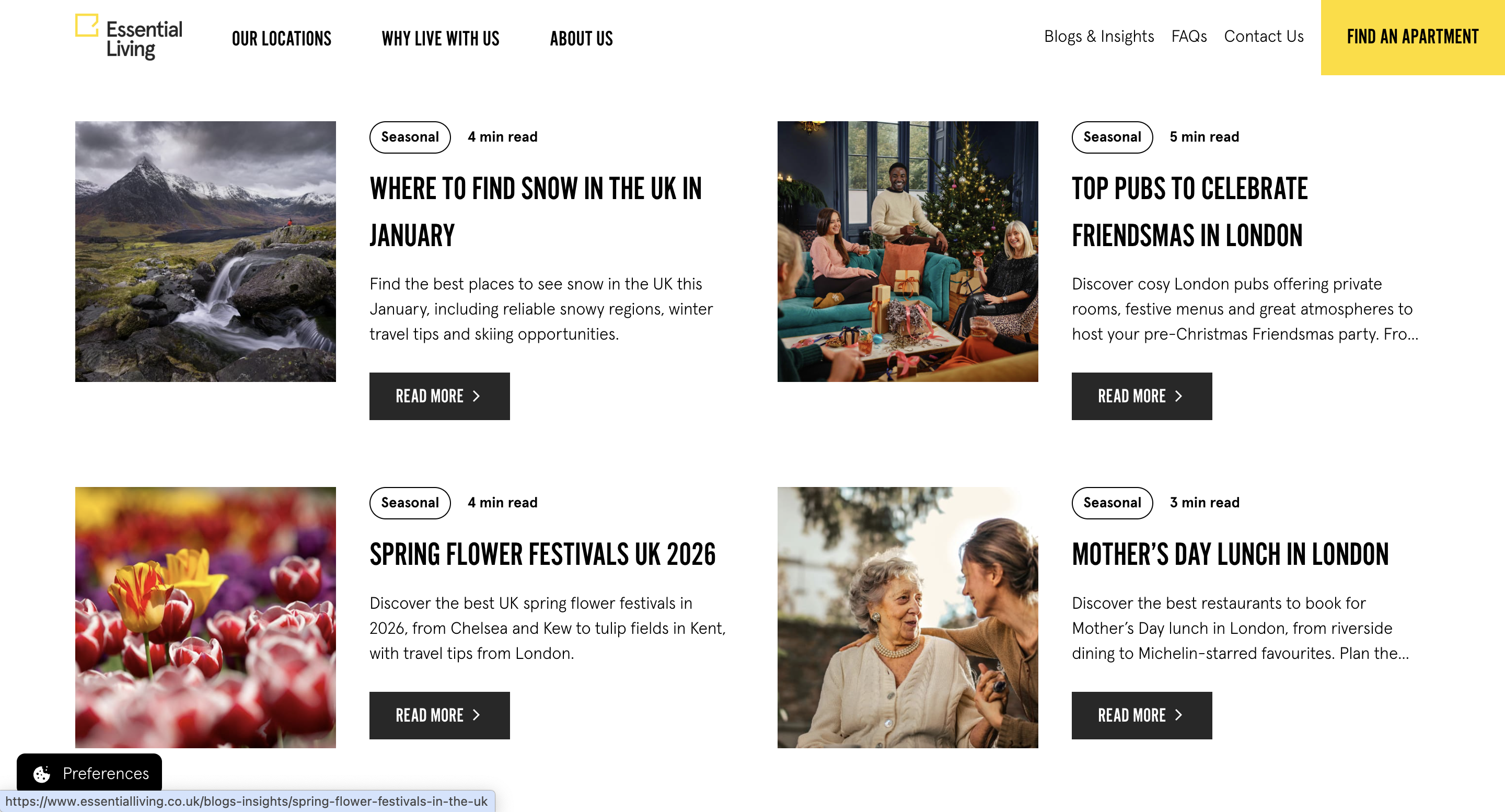
• Optimised Conversion Funnels: Overhauled the button hierarchy site-wide by standardising primary/secondary button states, updating labelling for action-oriented clarity, and eliminating dead ends with high-visibility CTAs.
• Structured Real Estate & FAQ Schema: Embedded dedicated property schema to protect local search equity, alongside a custom FAQ component with FAQ schema optimised for Google Rich Snippets and Generative Engine Optimisation (GEO).
• Enhanced Editorial Experience: Upgraded the /blogs-insights/ template with a sticky left-hand anchor link navigation bar, estimated reading times, and a refined category taxonomy to drive on-page engagement.
• Audited site-wide buttons and added strategic CTAs to streamline booking journeys
• Added high-intent CTAs to reduce user drop-off
• Wireframed user journeys and site hierarchy in Relume
• Designed sticky anchor links and read times for blogs.
• Cleaned and migrated 153 apartment listings using Claude/AI
• Structured Webflow CMS fields and property templates
• Partnered with senior developers on pre-flight launch audits
• Led complete cross-device UAT and link validation
• Implemented real estate schema across property pages
• Built dedicated FAQ blocks with schema for GEO rankings
• Executed comprehensive 301 redirect mapping from Kentico
• Managed content quality across staging and production
Replatforming wasn't just a defensive response to Kentico’s sunset; it was an opportunity to modernise our entire digital workflow and commercial funnel. By pairing rapid wireframing in Relume, a comprehensive conversion and CTA overhaul, AI-assisted data migration, and expert developer pre-flight audits, we delivered an enterprise-ready Webflow site in-house, cutting £20k in development costs while elevating both user journeys and search performance.
Get in touch to discuss your next project.